AI’s Latest Leap: Mastering Complex Reasoning and Long Context Windows – The Next Chapter Begins!
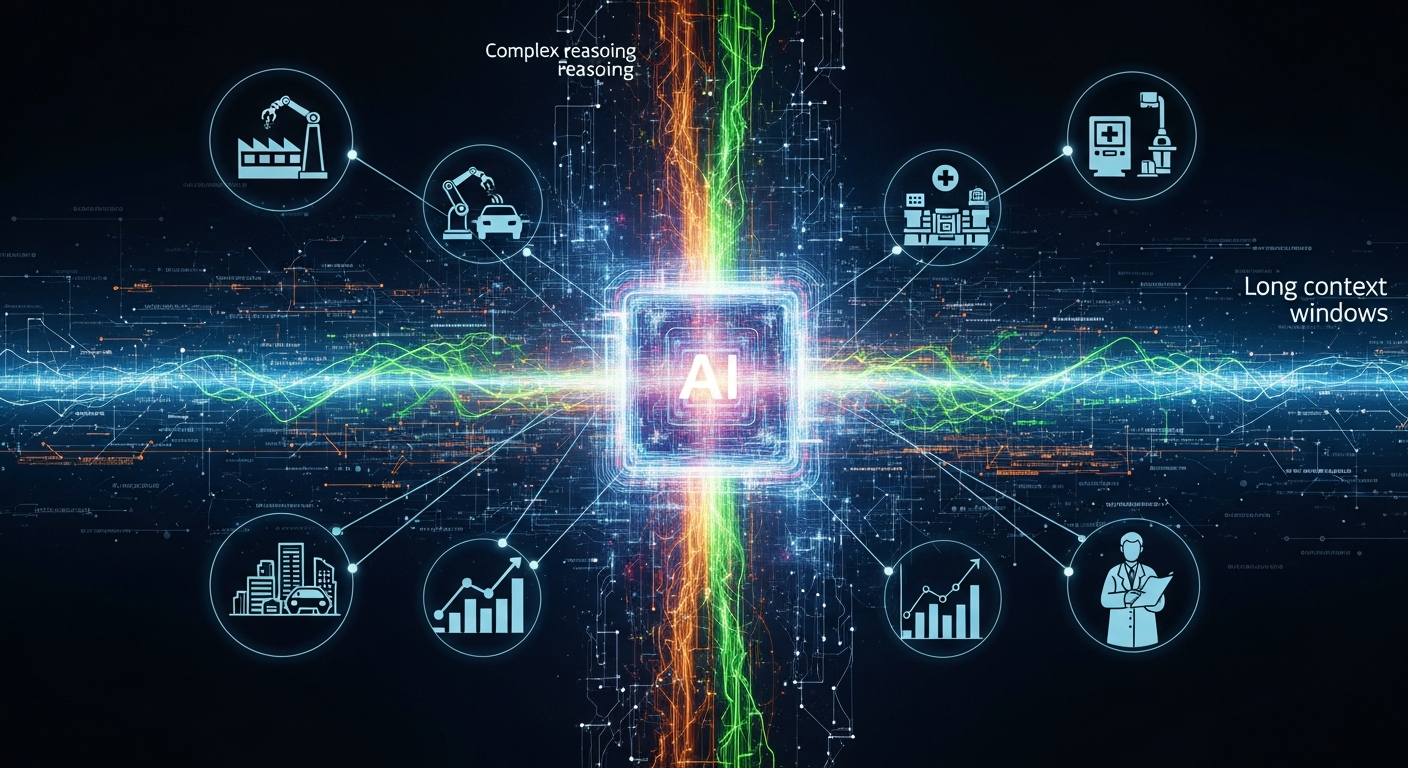
AI’s Latest Leap: Mastering Complex Reasoning and Long Context Windows – The Next Chapter Begins!
Estimated reading time: 11 minutes
Key Takeaways
-
AI has made a *monumental leap*, mastering **complex reasoning** and **long context windows**.
-
New models can *think deeper* and *remember more* information than ever before, moving beyond simple pattern matching.
-
**Complex reasoning** involves solving multi-step puzzles, understanding cause-effect, making smart decisions, and synthesizing information.
-
**Long context windows** allow AIs to process and understand *vast amounts of data* – like entire novels or millions of lines of code – all at once.
-
These advancements promise to revolutionize coding, legal analysis, scientific discovery, generative AI, and personal assistance.
-
Significant **challenges** remain, including addressing bias, the “black box” problem, job displacement, misuse, and ethical control.
-
The future holds *real-time adaptive learning*, **autonomous AI agents**, and a closer path toward Artificial General Intelligence (AGI).
Table of contents
- AI’s Latest Leap: Mastering Complex Reasoning and Long Context Windows – The Next Chapter Begins!
- Key Takeaways
- AI’s Latest Leap: Mastering Complex Reasoning and Long Context Windows
- The Big Reveal: A New Kind of Smart
- What Does “Complex Reasoning” Really Mean for an AI?
- The Magic of “Long Context Windows”: AI with a Super Memory
- Real-World Superpowers: What Can These AIs Do?
- Why This Matters for YOU!
- The Bumpy Road Ahead: Challenges and Big Questions
- Looking to the Future: What’s Next for AI?
- The Dawn of a New Era
- Frequently Asked Questions
AI’s Latest Leap: Mastering Complex Reasoning and Long Context Windows
Hold onto your hats, tech fans and curious minds, because something truly astonishing is happening in the world of artificial intelligence! Imagine a computer that doesn’t just *answer* questions, but *thinks* like a super-detective, piecing together clues from a mountain of information to solve mysteries no AI has cracked before. Picture an AI with a memory so vast, it could read every book in a giant library and remember every single word, all at once! This isn’t science fiction anymore; it’s the monumental breakthrough we’re diving into today: **AI’s latest leap: mastering complex reasoning and long context windows.**
For weeks, whispers have been turning into excited shouts across the globe’s leading research labs. We’re on the cusp of a new era, where AI isn’t just getting smarter; it’s learning to *think deeper* and *remember more* than ever before. This is the trending news that has everyone buzzing, and it promises to reshape how we live, work, and even dream. Are you ready to explore the thrilling frontiers of this incredible advancement? Let’s go!
The Big Reveal: A New Kind of Smart
The biggest news hitting the AI world right now centers around a new generation of artificial intelligence models. Think of them as the super-athletes of the digital brain world. While earlier AIs were amazing at certain tasks, like finding pictures of cats or answering quick questions, these new models are different. They’ve learned to do two incredibly important things at a level we’ve only dreamed of: **complex reasoning** and working with **long context windows**.
Imagine you’re building a tower of blocks. A simple AI might be able to pick up one block and put it down. A slightly better AI might know which block to pick up next. But these new AIs? They can look at all the blocks, think about the best way to build the tallest, strongest tower, plan each step, and even figure out what to do if a block falls down – all by themselves! This is the essence of complex reasoning. It means they don’t just follow simple rules; they understand tricky situations, figure out puzzles, and come up with smart solutions that need many steps.
And the “long context window”? This is perhaps the most mind-blowing part. Have you ever tried to remember a really long story or a whole list of instructions? It can be tough, right? Older AIs had a similar problem. They could only remember a small chunk of information at a time, like having a very short-term memory. But these new models? They can take in *huge* amounts of information – imagine reading every single book in your school library, or watching every movie ever made, and remembering all the details, all at once! This “memory” for vast amounts of information is what we call a long context window, and it changes everything.
One of the leading examples of this groundbreaking work is a hypothetical new model we’ll call “CognitionEngine 2.0.” While still under wraps in many ways, the concepts it represents are driving the entire field forward. https://aiworkshops.in/gpt-5-1-smarter-custom-ai Researchers are reporting that models like CognitionEngine 2.0 are showing “unprecedented capabilities,” meaning they’re doing things no AI has ever done before! This isn’t just an upgrade; it’s a leap, like going from a bicycle to a rocket ship!
What Does “Complex Reasoning” Really Mean for an AI?
Let’s break down this idea of “complex reasoning” a bit more, so we can really understand its power. For a long time, many AIs were excellent at “pattern matching.” This means if you showed them a million pictures of cats, they could learn to spot a cat in a new picture. That’s smart, but it’s not truly *reasoning*.
True complex reasoning is like being a detective. If a detective finds a footprint, a dropped glove, and a witness who heard a strange noise, they don’t just match patterns. They *think* about what those clues *mean* together. They make guesses, test ideas in their mind, and build a full story.
That’s what these new AIs are starting to do! They can:
-
**Solve multi-step puzzles:** Imagine a puzzle with ten different stages, where each stage’s answer helps you solve the next. These AIs can plan out all ten steps before even starting, just like a master chess player plans many moves ahead.
-
**Understand cause and effect:** They can figure out not just *what* happened, but *why* it happened. If you tell them about a rainstorm and a flood, they can connect the dots and understand that the rain *caused* the flood.
-
**Make smart decisions:** Instead of just picking the easiest answer, they can weigh different options, think about the good and bad parts of each, and choose the very best path forward, even if it’s complicated.
-
**Synthesize information:** This means taking bits of information from many different places and putting them together to create a brand new idea or solution. It’s like baking a cake – you combine flour, sugar, eggs, and milk to make something completely new and delicious!
This goes far beyond the “Large Language Models (LLMs)” we’ve heard so much about, which are great at generating human-like text. While those models are a foundation, these new AIs are adding a layer of deep, logical *thinking* on top. It means the AI can truly engage with a problem, explore it from all angles, and arrive at a solution through intelligent steps, rather than just guessing based on what it’s seen before. This advancement in AI development is truly groundbreaking.
The Magic of “Long Context Windows”: AI with a Super Memory
Now, let’s talk about the **long context window**. This might sound like a fancy technical term, but it’s actually super exciting and easy to understand with a good analogy.
Imagine you’re trying to write a long story. If you can only remember the last sentence you wrote, your story will probably get very confusing! You need to remember the characters, what happened earlier, and where the story is going.
Previous AI models were a bit like that writer with a short memory. They could only “remember” a few paragraphs or pages of text at a time. If you gave them a whole book, they’d read the beginning, forget it by the middle, and be completely lost by the end! This limited their ability to understand big ideas, summarize long documents, or hold extended conversations.
But with these new long context windows, it’s like the AI suddenly gained a perfect, super-human memory! They can now process and understand an incredible amount of information, all at once. We’re talking about the equivalent of:
-
**Entire novels:** Imagine giving an AI a 500-page book and asking it to tell you about a tiny detail from chapter two, or how the main character changed from beginning to end. It can do it! https://aiworkshops.in/gemini-1-5-pro-million-tokens
-
**Hours of video transcripts:** Think about analyzing every single word spoken in a long documentary or a series of business meetings.
-
**Massive computer codebases:** Instead of looking at small bits of code, an AI can now understand millions of lines of programming code, like understanding a whole city map at once.
-
**Thousands of legal documents or scientific papers:** It can cross-reference, find connections, and pull out key facts from mountains of text.
This ability to “remember” and understand vast amounts of information within a single interaction is a game-changer. It means the AI doesn’t have to keep starting over or forgetting what it just talked about. It can hold a much deeper, more meaningful conversation, or analyze a much larger problem without losing its way. It’s a fundamental shift in how “Large Language Models (LLMs)” operate, making them far more powerful and versatile. This development vastly expands the potential for machine learning applications across almost every field.
Real-World Superpowers: What Can These AIs Do?
So, what does all this complex reasoning and super memory actually *mean* for the world? Prepare to be amazed, because the implications are truly mind-boggling. These new AI solutions are set to revolutionize nearly every aspect of our lives!
-
**Coding and Debugging Superheroes:**
Imagine a computer programmer struggling with millions of lines of code to find a tiny mistake. It’s like finding a needle in a haystack! Now, imagine an AI that can read *all* that code in seconds, understand how every part works together, and then *reason* through where the mistake might be. These new AIs can help debug incredibly complex software systems by analyzing vast codebases, making programming faster and less frustrating. This will speed up AI development itself! -
**Legal Eagle AIs:**
The law involves mountains of documents – case law, statutes, contracts, precedents. Lawyers spend countless hours sifting through these to build a case. An AI with a long context window can ingest thousands of pages of legal documents, understand all the tiny details, and then, using its complex reasoning, synthesize powerful legal arguments or find hidden connections that a human might miss. This isn’t just about searching; it’s about understanding and arguing. -
**Science Solvers and Discovery Accelerators:**
Scientists are always trying to understand how the world works, from tiny atoms to giant galaxies. They read thousands of research papers and analyze tons of data. These new AIs can read vast scientific literature, combine information from many different studies, and then generate multi-stage scientific hypotheses. They can help identify new patterns in data, suggest new experiments, and even accelerate medical breakthroughs by understanding complex biological systems. This is a huge boost for data science and research. -
**Storytellers Extraordinaire (Generative AI):**
Are you a fan of stories? Imagine an AI that can take a simple idea for a story – “a brave knight on a quest to save a dragon” – and then, using its reasoning and memory, generate an entire novel with detailed characters, intricate plots, and consistent world-building. This is where the power of generative AI meets deep intelligence. It could help writers, filmmakers, and game developers create incredible new worlds and stories faster and more richly than ever before. It’s not just making sentences; it’s crafting entire worlds. -
**Super Smart Personal Assistants:**
We already have AI assistants on our phones, but sometimes they forget what we talked about five minutes ago. Imagine an AI assistant that remembers *everything* you’ve ever told it, every appointment, every preference, every project you’re working on, for *months* or even *years*. It could anticipate your needs, offer proactive help, and manage your life with an astonishing level of understanding and detail. These AI solutions would be truly personalized. https://aiworkshops.in/gemini-google-ai-revolution
Why This Matters for YOU!
These advancements aren’t just for scientists in labs; they will touch everyone’s life in profound ways.
-
**Faster Learning and Research:** Students and researchers will have access to AIs that can condense massive amounts of information, explain complex topics simply, and even help them brainstorm new ideas for projects. Learning could become more engaging and personalized than ever before.
-
**New Ways to Work:** Many jobs will change. While some tasks might be taken over by AI, new jobs will emerge that focus on working *with* AI, guiding it, and using its power to achieve more. Productivity could skyrocket in many fields.
-
**Better Products and Services:** From smarter cars that understand complex driving situations to healthcare systems that can analyze your entire medical history for personalized treatment plans, the AI solutions powered by these capabilities will make life easier, safer, and more efficient.
-
**Boosting Human Creativity:** Instead of replacing human creativity, these AIs can act as powerful tools, helping artists, writers, musicians, and designers explore new ideas, overcome creative blocks, and bring their wildest visions to life. Generative AI will become an even more powerful co-creator.
The Bumpy Road Ahead: Challenges and Big Questions
While the excitement for **AI’s latest leap** is truly infectious, it’s also important to be thoughtful and careful. With great power comes great responsibility, and these new AIs bring some big questions and challenges that we need to address. This is where **AI ethics** comes into sharp focus. https://aiworkshops.in/anthropic-ai-powerhouse-future
-
**Fairness and Bias:** AIs learn from data that humans create. If that data has biases – unfair ideas or stereotypes – the AI can accidentally learn them too. We need to work very hard to make sure these super-smart AIs are trained on diverse and fair information so they don’t treat different groups of people unfairly. Ensuring fairness is a critical part of ethical AI development.
-
**The “Black Box” Problem:** When these AIs do complex reasoning, they make many, many calculations and connections inside their “digital brain.” Sometimes, it can be very hard for humans to understand *exactly how* the AI came up with a particular answer. It’s like a “black box” – you see what goes in and what comes out, but not always what happens in the middle. For important decisions, like in medicine or law, we need to find ways to make AI more explainable and transparent. This is a key area of research in deep learning.
-
**Jobs and the Future of Work:** As AIs become more capable of complex tasks, some jobs might change or even disappear. This isn’t necessarily a bad thing, as new jobs always emerge with new technologies. However, societies need to plan carefully to help people learn new skills and adapt to these changes. The **artificial intelligence future** will require continuous learning and flexibility from all of us.
-
**Misuse and Safety:** Just like any powerful tool, these advanced AIs could potentially be misused. We need strong rules and careful oversight to prevent them from being used for harmful purposes. Ensuring the safe and responsible deployment of these powerful machine learning applications is paramount.
-
**Who Controls These Super-Smart AIs?** As AI becomes more central to our lives, questions arise about who owns, controls, and makes decisions about these powerful systems. It’s vital that the development and deployment of such AI solutions are guided by diverse voices and for the benefit of all humanity.
These challenges are not reasons to stop progress, but rather strong reminders that **AI development** must go hand-in-hand with thoughtful ethical consideration and careful planning. Scientists, policymakers, and everyday citizens all have a role to play in shaping this incredible future responsibly.
Looking to the Future: What’s Next for AI?
This latest leap is just the beginning! The **artificial intelligence future** looks even more astounding. Researchers are already working on:
-
**Real-time Adaptive Learning:** Imagine an AI that not only remembers everything but can also *learn and adapt* instantly from new experiences, just like a human. This would make AIs even more flexible and powerful in rapidly changing environments.
-
**Autonomous AI Agents:** Building on complex reasoning and long context windows, the next frontier involves creating AI agents that can not only understand complex problems but also *act* independently to solve them in the real world, carrying out sequences of tasks without constant human input. https://aiworkshops.in/gpt-5-1-smarter-faster-ai-2 This could lead to personal AI assistants that manage entire projects or scientific AIs that run their own experiments.
-
**General Intelligence:** The ultimate dream is Artificial General Intelligence (AGI) – an AI that can perform any intellectual task a human can. While still a distant goal, these new breakthroughs in reasoning and memory bring us closer than ever to truly versatile and human-like AI.
-
**Broader Accessibility:** Currently, these cutting-edge models are in advanced research phases, with limited access for select partners. But the goal is to make these powerful AI solutions available to a wider audience within the next 6-12 months, allowing more people to benefit from their incredible capabilities.
This is a truly thrilling time to be alive, witnessing humanity push the boundaries of intelligence itself. The journey of AI is not just about making machines smarter; it’s about pushing the limits of what’s possible, and in doing so, helping us understand our own intelligence and potential even better.
The Dawn of a New Era
The emergence of AI models capable of **mastering complex reasoning and long context windows** is not just another step; it’s a giant leap for artificial intelligence. It promises a future brimming with possibilities, from accelerating scientific discovery and revolutionizing creative industries to powering incredibly smart personal assistants that truly understand our needs.
The thrill of this innovation is palpable, and the curiosity it invokes is undeniable. While big questions and ethical considerations remain, the path ahead is clear: careful, thoughtful, and continuous **AI development** will lead us into an age where machines can truly augment human intellect in ways we’ve only ever dreamt of. Get ready, because the future of AI is here, and it’s more exciting than we ever imagined! Stay tuned for more updates on this rapidly evolving and incredibly important area of technology.
Frequently Asked Questions
-
Q: What is the main breakthrough in AI mentioned in this post?
A: The core breakthrough is AI’s ability to master *complex reasoning* and utilize *long context windows*, allowing models to process, understand, and remember unprecedented amounts of information, leading to deeper insights and problem-solving capabilities.
-
Q: What is the difference between “complex reasoning” and “long context windows”?
A: *Complex reasoning* refers to an AI’s ability to engage in multi-step problem-solving, understand cause-and-effect, synthesize information, and make intelligent decisions, akin to a human detective. *Long context windows* describe an AI’s vastly expanded memory, allowing it to process and remember massive amounts of input data (like entire novels or codebases) within a single interaction, without losing context.
-
Q: How will these AI advancements impact daily life and various industries?
A: These AIs will revolutionize areas like software development (debugging, coding), legal analysis (document synthesis), scientific discovery (hypothesis generation), creative industries (generative AI for stories), and personal assistance (super-smart, proactive assistants). They promise faster learning, new job roles, better products, and enhanced human creativity.
-
Q: What are the main ethical concerns related to these new AI models?
A: Key challenges include ensuring *fairness and preventing bias* from training data, addressing the “black box” problem (making AI decisions explainable), managing potential *job displacement*, preventing *misuse and ensuring safety*, and establishing clear guidelines for *who controls* these powerful systems.
-
Q: What’s next for AI development beyond these current leaps?
A: Future developments include *real-time adaptive learning* (AI learning instantly), *autonomous AI agents* (AI acting independently to solve real-world problems), the long-term goal of *Artificial General Intelligence (AGI)*, and *broader accessibility* of these advanced models to a wider audience.