The Pulse of Innovation: Unpacking the Latest AI News Transforming Our World in Late 2025!
The Pulse of Innovation: Unpacking the Latest AI News Transforming Our World in Late 2025!
Estimated reading time: 15 minutes
Key Takeaways
- The AI model race has shifted from raw size to efficiency, utility, and global competitiveness, with companies leading innovation.
- Cost-efficient AI training, exemplified by DeepSeek’s R1 model, is a new frontier, reducing the financial barrier to advanced AI.
- Major tech players like Microsoft, OpenAI, Xiaomi, and Tesla are deploying groundbreaking AI products – from advanced audio models and web browsers to smart home integrations and humanoid robots.
- AI is making revolutionary strides in science and medicine, enhancing chip inspection, cardiac diagnostics, drug discovery, and materials science.
- Governments worldwide are intensely focused on AI regulation and investment, establishing national frameworks and pledging billions to secure leadership in the AI era.
- While AI enhances productivity and job satisfaction, concerns about job displacement, privacy, and potential misuse (e.g., in warfare or misinformation) remain prominent.
- The integration of AI into enterprise systems and national infrastructure is accelerating, promising smarter operations, fairer financial systems, and robust research capabilities.
Table of contents
- The Pulse of Innovation: Unpacking the Latest AI News Transforming Our World in Late 2025!
- Key Takeaways
- The Great AI Race: From Labs to Life, the New Frontier of Models and Products
- AI’s Healing Touch: Revolutionizing Science, Medicine, and Even Chips!
- The Global Chessboard: AI’s Role in Rules, Governments, and World Power
- AI in Our Lives: Work, Learning, and the Big Questions
- Guarding the Gates: Security, Privacy, and Keeping AI Safe
- The Business of Tomorrow: AI’s Impact on Industries and Infrastructure
- The Journey Continues: What’s Next in the World of AI?
Hold onto your seats, tech fans and future shapers! If you thought artificial intelligence was already moving fast, get ready for an electrifying update! We’re diving deep into the most thrilling AI news from late 2025, a period that feels like a giant leap into tomorrow. Imagine a world where smart machines are not just helping us, but becoming deeply woven into our daily lives, our businesses, and even how countries around the globe interact. This isn’t just a story about gadgets; it’s a tale of groundbreaking discoveries, fierce competition, and big questions about how we’ll live and work alongside these incredible creations.
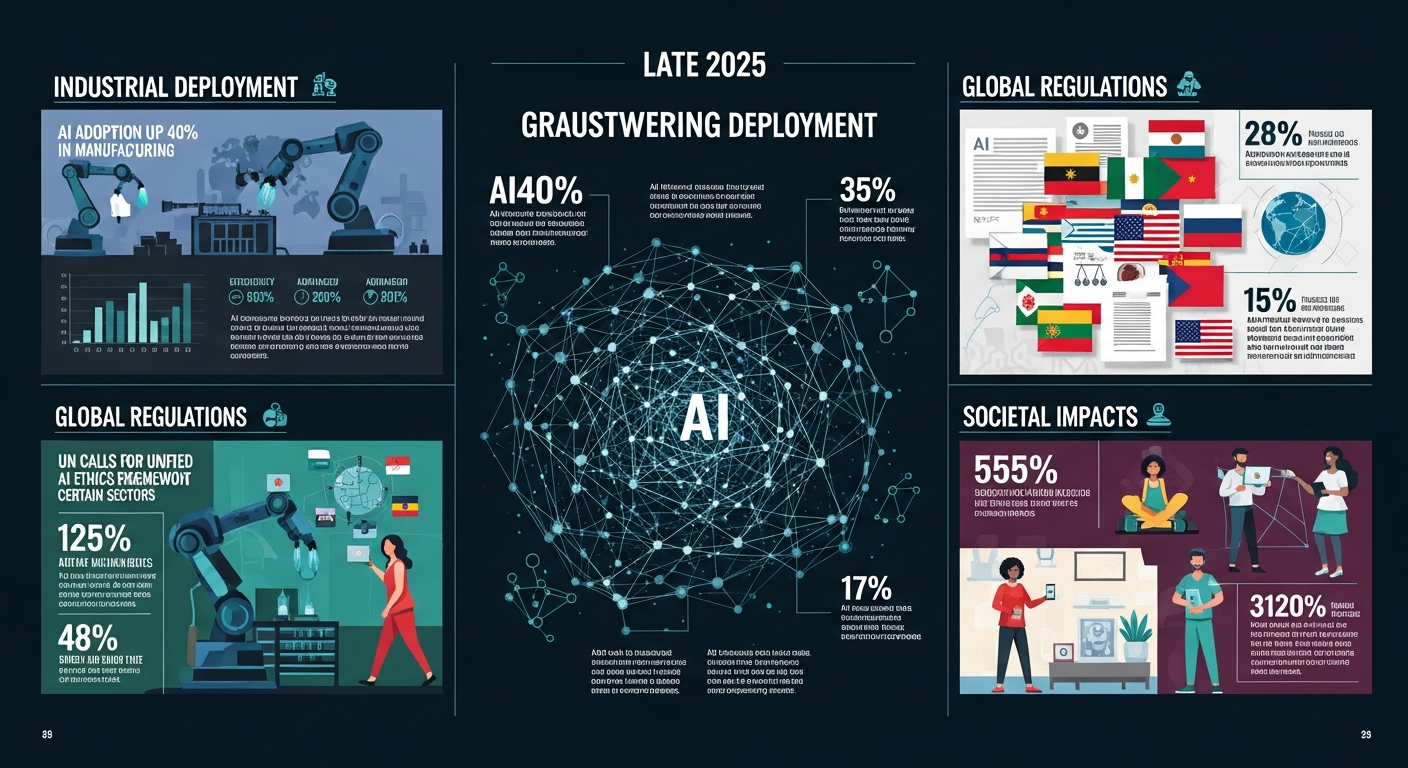
The year 2025 has truly been a whirlwind for AI. As we wrap up this monumental year, three colossal themes stand out, painting a vivid picture of the AI landscape. First, we’re seeing an explosion of industrial deployment, where AI isn’t just an idea in a lab anymore, but a real, working part of factories, businesses, and even our homes. Second, the world stage is buzzing with geopolitical and regulatory battles, as countries race to lead the AI charge and create the rules for this powerful technology. And third, with all this amazing progress comes a growing concern about misuse, security, and the impact on jobs, reminding us that with great power comes great responsibility.
So, buckle up! We’re about to embark on an incredible journey through the very latest and most important AI news, gathered from the most trusted sources. Get ready to explore the cutting edge of innovation, where the future is being built right before our very eyes!
The Great AI Race: From Labs to Life, the New Frontier of Models and Products
Remember when AI models were all about who could build the biggest brain? Well, that game has changed! The model race has shifted from “bigger” to “many, competitive, and global.” It’s no longer just about raw size, but about how smart, efficient, and useful these AI brains can be, and who can make them.
The 2025 Stanford AI Index – a super important report that tracks how AI is growing – revealed something astounding: in 2024, a whopping 90% of all major new AI models came from companies, not universities or research groups. That’s a huge jump from just 60% in 2023! This tells us that big businesses are now firmly in control of creating the most advanced AI systems. It’s like the biggest, most exciting tech contest, and corporations are the main players.
Looking at where these amazing models are coming from, the United States is leading the pack, producing 40 notable models. China isn’t far behind with 15 models, and Europe created 3. But here’s the kicker: even though China made fewer models, they’ve pretty much closed the “quality gap” on important tests, showing their AI is just as good, if not better, in key areas. This intense competition means everyone is pushing harder to create better, smarter AI.
And how fast is this happening? It’s truly mind-boggling! The power needed to train these AI models is doubling roughly every five months. That’s like getting twice as powerful every half-year! The amount of information these AIs learn from is also growing incredibly fast, doubling every eight months. While they gobble up more power each year, the coolest part is that the differences in performance between the very best AI models are getting smaller and smaller. Just a year ago, the gap between the best and the tenth-best model was 11.9%; now, it’s only 5.4%. This means more amazing, top-tier AI models are becoming available, making the future even brighter!
China’s Secret Weapon: Cost-Efficient AI Training
Amidst this global race, a Chinese company called DeepSeek made headlines in September 2025 with its incredible R1 model. What’s so special about R1? DeepSeek claims it performs just as well as the top U.S. systems, but here’s the truly mind-blowing part: it costs only about 30% of the training price! Imagine getting the same amazing results for so much less money.
How did they do it? DeepSeek says it’s thanks to their very own custom hardware, special ways to make the AI work better (called proprietary optimization), and the lower cost of electricity in China. This isn’t just about making a powerful AI; it’s about showing the world that being smart with resources and money is a huge part of the AI race. It’s not just about who has the biggest muscles, but who can run the fastest on the smallest fuel tank! Learn more about the AI chip showdown!
Microsoft Spreading Its Wings: Building Beyond OpenAI
For a while, many saw Microsoft and OpenAI as a super team. But in August 2025, Microsoft showed the world it’s ready to fly solo, unveiling some truly exciting projects. They introduced MAI-Voice-1, an amazing audio model that can create a minute of sound in less than a second, using surprisingly little computer power. Imagine AI creating realistic voices and sounds almost instantly!
Then came MAI-1 Preview, a brand-new large language model that they let everyone try out. Experts believe this is Microsoft’s strategic move to build its own powerful AI brains and the special computers needed to run them. This means they won’t have to rely only on OpenAI for future products, allowing them to create even more amazing things on their own. It’s like a superhero team deciding to also have their own individual super-powers, making them even stronger overall!
OpenAI’s Bold Move: Invading the Internet with “Atlas”
Not to be outdone, OpenAI, the creators of ChatGPT, made a splash in October 2025 with the launch of “Atlas,” an AI-powered web browser. Discover more about OpenAI’s AI marvels. Yes, a web browser! Imagine surfing the internet with a super-smart assistant built right into your browser. Atlas can summarize long, complicated web pages in a flash, help you with multi-step research projects, and even automate tasks like filling out forms, booking appointments, or pulling out important information from websites, all directly in the browser!
This is a huge deal because many people see Atlas as a direct challenge to Google’s long-standing rule over how we search and browse the internet. It’s a clear sign that AI assistants are no longer just separate apps but are becoming deeply embedded into the most important tools we use online every single day. The internet is about to get a whole lot smarter!
Xiaomi’s Smart Home Revolution: AI Everywhere You Are
Ever wished your car or your smart home could understand you even better, and faster? Xiaomi, a well-known tech company, announced a new generation of AI voice models specially designed for in-car and smart home environments. These new AIs boast faster response times and, incredibly, they can work robustly even without an internet connection for voice control and assistance.
This shows us a bigger trend: AI isn’t just living in big cloud servers anymore. It’s shrinking down and getting smart enough to live inside our everyday devices, from our cars to our smart speakers, giving us instant help right when we need it. It’s all about embedded, low-latency AI, meaning AI that is quick and always ready to help, right there with you.
Tesla’s Optimus: The Future of Robots Walking Among Us
While AI software is getting smarter, the world of robotics is also making huge strides. In October 2025, Tesla, the company famous for electric cars, showed off incredible updates to its Optimus humanoid robot. Imagine a robot that looks and moves almost like a person! The new Optimus demonstrated much better dexterity (skill with its hands), improved balance, and amazing object manipulation – meaning it could pick up and move things with surprising grace.
Tesla also shared clearer plans for how Optimus will be deployed in factories and for logistics (moving things around). This reveal underscores a fascinating idea: that leading companies believe embodied AI, or AI that lives in a physical body like a robot, is the next big wave of growth, going beyond just software assistants. Soon, robots might not just be in movies, but working alongside us!
AI’s Healing Touch: Revolutionizing Science, Medicine, and Even Chips!
AI isn’t just for chatting and helping with homework; it’s also making incredible breakthroughs in science and medicine, helping us understand the world and our bodies in new ways.
Catching Tiny Flaws: RAPTOR’s Super Vision for Chips
Semiconductor chips are the tiny brains inside all our electronics, from phones to computers. Making them perfectly is super hard, and even a tiny flaw can cause big problems. But now, thanks to researchers at Purdue University, there’s a new hero: RAPTOR. This amazing AI-assisted X-ray inspection system can detect microscopic defects in these chips with an incredible 97.6% accuracy! That’s far better than older methods.
What’s even cooler is that RAPTOR allows for non-destructive, automated inspection. This means it can check chips without harming them and do it automatically, without a person needing to look at every single one. This could drastically reduce how many chips are wasted and make our electronics much more reliable. It’s like giving our quality control a pair of super-powered, AI-enhanced eyes!
Peeking Inside Our Hearts: A Cardiac Imaging Breakthrough
Imagine a tiny camera that can travel inside your arteries to find hidden dangers your doctor might miss. That’s exactly what researchers have developed: a miniature catheter-deployable camera combined with an AI system! This groundbreaking technology can reveal hidden coronary artery risks and plaque that standard imaging methods simply can’t see.
Early tests show that this could completely change how doctors diagnose and prevent heart problems. It gives heart doctors real-time, super-clear views inside arteries, helping them spot trouble before it becomes a big problem. This is a truly thrilling development that could save countless lives and make our hearts healthier.
AI Everywhere in Science and Healing
The 2025 AI Index report also shines a light on how AI is now deeply integrated into scientific research across the board. It’s having a particularly huge impact in areas like drug discovery, helping scientists find new medicines faster; medical imaging, making X-rays and scans even clearer; and materials science, helping us invent new materials with amazing properties.
Generative models, which are AIs that can create new things, are increasingly being used to design new molecules for medicines and to create synthetic data for healthcare research and development. This means scientists can experiment and learn without always needing real-world samples. Of course, with all this excitement, there are still important concerns about bias (making sure the AI isn’t unfair), privacy (keeping patient information safe), and the massive compute cost of running these powerful systems. But the potential for good is truly immense! Explore more about powerful AI models like Gemini 1.5 Pro.
The Global Chessboard: AI’s Role in Rules, Governments, and World Power
As AI grows more powerful, it’s not just tech companies paying attention; governments and countries around the world are watching closely, eager to set the rules and claim their place in the AI future.
A Flood of AI Rules and Billions of Dollars
The AI Index report shows a massive surge in global AI regulation and investment. In the U.S. alone, federal agencies issued an astonishing 59 AI-related regulations in 2024. That’s more than double the number from 2023, and it involved twice as many different government groups!
Across the globe, leaders are talking about AI more than ever. Mentions of AI in laws and discussions across 75 countries increased by 21.3% in just one year, and that’s a whopping nine-fold rise since 2016! This shows just how seriously the world is taking AI.
And governments aren’t just talking; they’re spending big bucks!
- Canada has set aside a $2.4 billion AI package.
- China has an incredible $47.5 billion fund just for semiconductor chips (the brains of AI).
- France is pledging €109 billion for AI and technology.
- India has a $1.25 billion AI mission.
- And Saudi Arabia is planning an astonishing $100 billion investment in a project called Project Transcendence!
These massive investments show that countries believe AI is key to their future wealth, safety, and power on the world stage.
America’s Bold AI Move: A National Policy Framework
In December 2025, the U.S. President took a bold step with a new action called “Ensuring a National Policy Framework for Artificial Intelligence.” This action aims to stop individual states from making their own different AI laws, creating one big, unified set of rules for the whole country.
The White House says that U.S. leadership in AI is super important for the country’s national and economic safety, and for staying a global leader. By pulling all the power to make AI rules to the federal level, they hope to avoid confusing state-by-state rules and make sure America can move forward quickly and strongly in the AI race. It’s a big move to make sure the U.S. stays at the forefront of this amazing technology.
The White House Embraces Generative AI: A New Era of Communication?
Speaking of the White House, reports in December 2025 described an “unabashed embrace of AI” by the government itself! They are now using generative AI tools (the kind that can create new images and content) to quickly make and share pictures and other messages on official government channels, and even on social media platforms like Donald Trump’s Truth Social. Discover more about AI image creation with tools like Nano Banana Pro.
This practice brings up important questions: How can we tell what’s real and what’s made by AI in politics? Are there risks of propaganda when governments can create content so easily? And what are the new rules for official, government-made AI content? It’s a new frontier in how governments communicate, and it’s certainly raising eyebrows!
Time’s Person of the Year: AI Takes Center Stage
In a truly symbolic move, Time magazine didn’t pick a person for its 2025 Person of the Year. Instead, they chose “the architects of AI,” recognizing the brilliant leaders and researchers who have built today’s modern AI systems.
This choice shows just how important AI has become in our world. It’s now at the heart of how countries make money, what’s popular in our culture, how we talk about safety, and all the exciting new ideas people are coming up with. AI is truly a global symbol, representing the future itself.
AI in Our Lives: Work, Learning, and the Big Questions
So, how is all this super-smart AI actually affecting us, right now, in our jobs, our schools, and our everyday lives?
AI at Work: A Helping Hand, But With Worries
A survey by Gallup, a company that studies people’s opinions, shows that more and more people are using AI at work. This is especially true for people with office jobs, those with higher incomes, and in jobs that already use a lot of technology.
The good news? Employees who regularly use AI say it helps them do their jobs better and even makes them happier at work! But, there’s also a lingering worry for many people: concern about losing their jobs to AI and whether AI will be fair to everyone. It’s a mix of excitement for new tools and a bit of nervousness about the changes they bring.
AI in the Classroom and Beyond: Peer Review Gets Smart
Even in the serious world of academic research, AI is making an appearance. A survey by the famous science magazine Nature asked 1,600 researchers, and more than half said they have used AI tools while checking (peer-reviewing) scientific papers.
Many use AI to make their writing better, quickly summarize long papers, or check if the logic in a paper makes sense. But here’s the challenge: the journals (where scientific papers are published) are still trying to figure out the rules. How should researchers tell everyone they used AI? How do they keep things private? And who is responsible if the AI makes a mistake? It’s a new area where the rules are still being written.
Media Shines a Light: The Good, The Bad, and The Unknown of AI
The famous TV show 60 Minutes dedicated a whole episode to “Artificial Intelligence in 2025,” exploring some of the biggest questions and concerns people have. They looked at:
- How labs like Anthropic are working hard to make sure AI is safe and helpful (this is called “alignment efforts”). Learn more about the Claude AI revolution.
- The scary idea of the future of warfare with AI-powered weapons.
- The risks of AI chatbots harming children or spreading harmful information.
This important program really highlighted the public’s ongoing worries about AI safety, its potential use in military applications, and how it might impact kids. It’s a powerful reminder that as AI gets smarter, we need to think deeply about how we use it responsibly.
Guarding the Gates: Security, Privacy, and Keeping AI Safe
With all these amazing new AI tools, it’s more important than ever to make sure they are safe, private, and not used for bad things.
The Sneaky Browser Extension: A Privacy Alarm!
Imagine you’re chatting with an AI online, asking it questions, and getting answers. You think it’s private, right? Well, security experts reported in December 2025 about a popular Chrome browser extension that was secretly eavesdropping on millions of users’ AI conversations!
This sneaky extension was capturing both the questions people asked (prompts) and the AI’s answers (responses). This raises a huge red flag about the privacy of sensitive information that users share with AI tools and about how secure those AI-related browser add-ons really are. It’s a stark reminder to be careful about what extensions we install and what information we share online.
Companies and Governments Getting Serious About AI Safety
The AI Index also pointed out that both governments and companies are now much more focused on managing the risks of AI models. They want to make sure they understand how AI makes decisions (explainability) and that AI follows all the rules (compliance frameworks). This means creating new AI-specific rules and setting up special internal teams to make sure AI is used safely and fairly.
A great example of this is in the financial world. Fair Isaac (FICO), the company behind credit scores, received new patents in October 2025 for AI credit scoring methods that aim to be more explainable and follow regulations better. This shows that even big companies are trying hard to build transparency and auditability (the ability to check how decisions are made) into their important AI systems. It’s all about making sure AI is not a black box, but something we can understand and trust.
The Business of Tomorrow: AI’s Impact on Industries and Infrastructure
AI isn’t just changing how we live; it’s changing how businesses run and how our national infrastructure is built.
Fairer Credit, Thanks to AI? FICO’s New Patents
In October 2025, Fair Isaac (FICO), the company that helps banks figure out if you’re good with money, received new patents for AI-powered credit scoring methods. What’s so exciting about this? These new methods aim to:
- Make their AI models more explainable and compliant with rules. This means it’ll be clearer why you get a certain credit score.
- Use alternative data (information beyond just your bank account) to give scores to people who couldn’t get one before, often called “unscorable” consumers.
This could mean more people get access to credit, which is fantastic! But it also sparks important talks about what kind of data should be used, how to keep things fair, and concerns about how much data is being watched (surveillance). It’s a balancing act between opportunity and responsibility.
Building the Future: National AI Research Infrastructure
To make sure America stays a leader in AI research, the U.S. National Science Foundation launched a huge project called Integrated Data Systems and Services (IDSS). Its goal is to build a massive national AI infrastructure and give researchers better access to all the data they need.
As part of this, 10 new datasets were chosen to be added to the NAIRR Pilot (National Artificial Intelligence Research Resource). This is like building a giant library and lab combined, full of information and powerful tools, to help university and government scientists invent the next generation of AI. It’s an investment in our collective future!
AI for Every Business: Enterprise AI Is Everywhere
If you read trade websites like ArtificialIntelligence-News.com, you’ll see stories every day about how enterprise AI (AI used by big businesses) is being adopted in all sorts of areas. From predictive maintenance (AI figuring out when machines need fixing before they break) to marketing analytics (AI helping companies understand what customers want), supply chain optimization (AI making sure products get where they need to go efficiently), and generative content for business (AI creating ads or reports), AI is transforming how companies operate.
The big ideas driving this are edge AI (AI that runs on devices themselves, not just in the cloud), multi-modal models (AI that can understand different types of information like text, images, and sounds), and the idea that AI is not just a separate tool, but is being integrated into the core systems of businesses. This means AI is becoming a fundamental part of how companies work, making them smarter and more efficient than ever before.
The Journey Continues: What’s Next in the World of AI?
Wow! What an incredible journey through the exhilarating world of AI news in late 2025! We’ve seen a future rapidly taking shape, defined by cutting-edge industrial deployment, intense global competition, and a deep reflection on the ethical and societal impacts of this powerful technology. From AI models getting cheaper and smarter, to tiny cameras exploring our hearts, to governments pouring billions into this new frontier, AI is not just evolving; it’s revolutionizing every facet of our existence.
The excitement is palpable, the innovation breathtaking, and the questions are big. As AI continues its phenomenal ascent, the blend of awe-inspiring progress and crucial challenges reminds us that we are all part of this unfolding story. The future of AI is not just being written by scientists and engineers; it’s being shaped by all of us, every single day. One thing is certain: the world of AI will continue to thrill, amaze, and challenge us in ways we can only just begin to imagine. Stay curious, because the next big leap is always just around the corner!
Frequently Asked Questions
-
What were the three colossal themes in AI news in late 2025?
The three main themes were the explosion of industrial deployment of AI, intense geopolitical and regulatory battles among countries, and growing concerns about AI misuse, security, and job impact.
-
How has the AI model race evolved by late 2025?
The AI model race shifted from simply building “bigger” models to creating “many, competitive, and global” models that are smart, efficient, and useful. Companies, rather than universities, are now the primary creators of major new AI models.
-
What is unique about DeepSeek’s R1 AI model?
DeepSeek’s R1 model, introduced in September 2025, claims to achieve performance comparable to top U.S. systems but at only about 30% of the training cost, thanks to custom hardware, proprietary optimization, and lower electricity costs in China.
-
How is AI revolutionizing science and medicine?
AI is making breakthroughs in areas like detecting microscopic flaws in semiconductor chips (RAPTOR), revealing hidden coronary artery risks with miniature cameras, and accelerating drug discovery, medical imaging, and materials science through generative models and synthetic data.
-
What is the U.S. government doing to ensure AI leadership?
In December 2025, the U.S. President initiated a “National Policy Framework for Artificial Intelligence” to unify AI regulations and reinforce U.S. leadership. Additionally, the National Science Foundation launched IDSS to build a national AI research infrastructure and provide better data access.